Aluminium Based Alloys

MetalFab systems process a wide range of metal materials to meet the most demanding applications

Process parameters developed by our in-house team of process engineers and metallurgy experts
Additive Industries operate within a Process Readiness Level (PRL) framework to control the development, and release of new metal materials for our systems.
This PRL approach allows us to systematically develop process parameters for new and existing materials based on clear customer and industry requirements and release them to our customers with confidence in their performance, as well as a clear understanding of their level of maturity.
The open architecture of the MetalFab system means that customers can still however develop their own process parameters or modify the baseline parameters provided by Additive Industries for their specific applications.
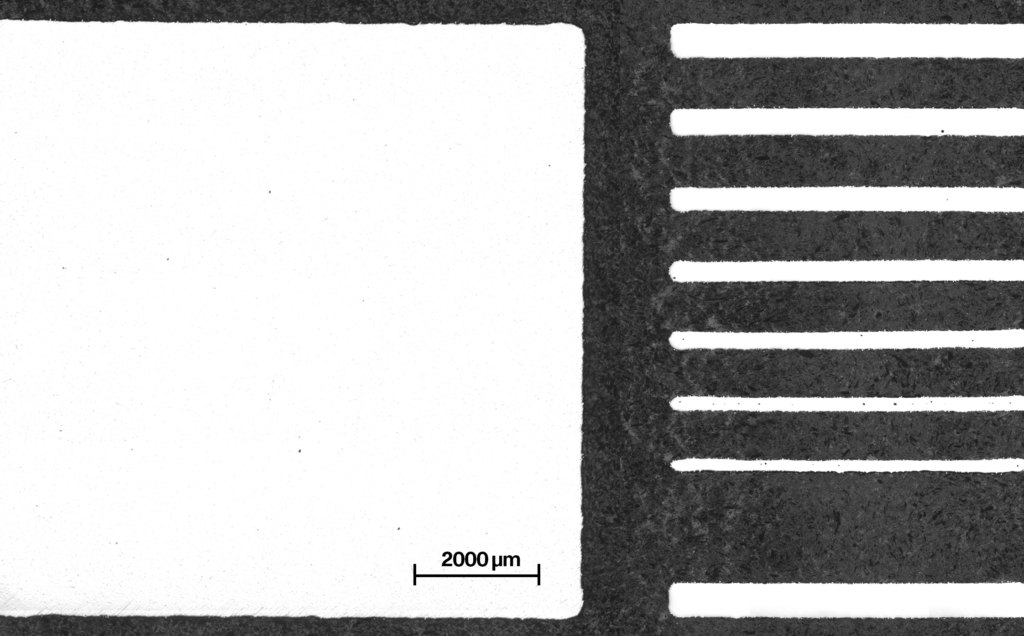
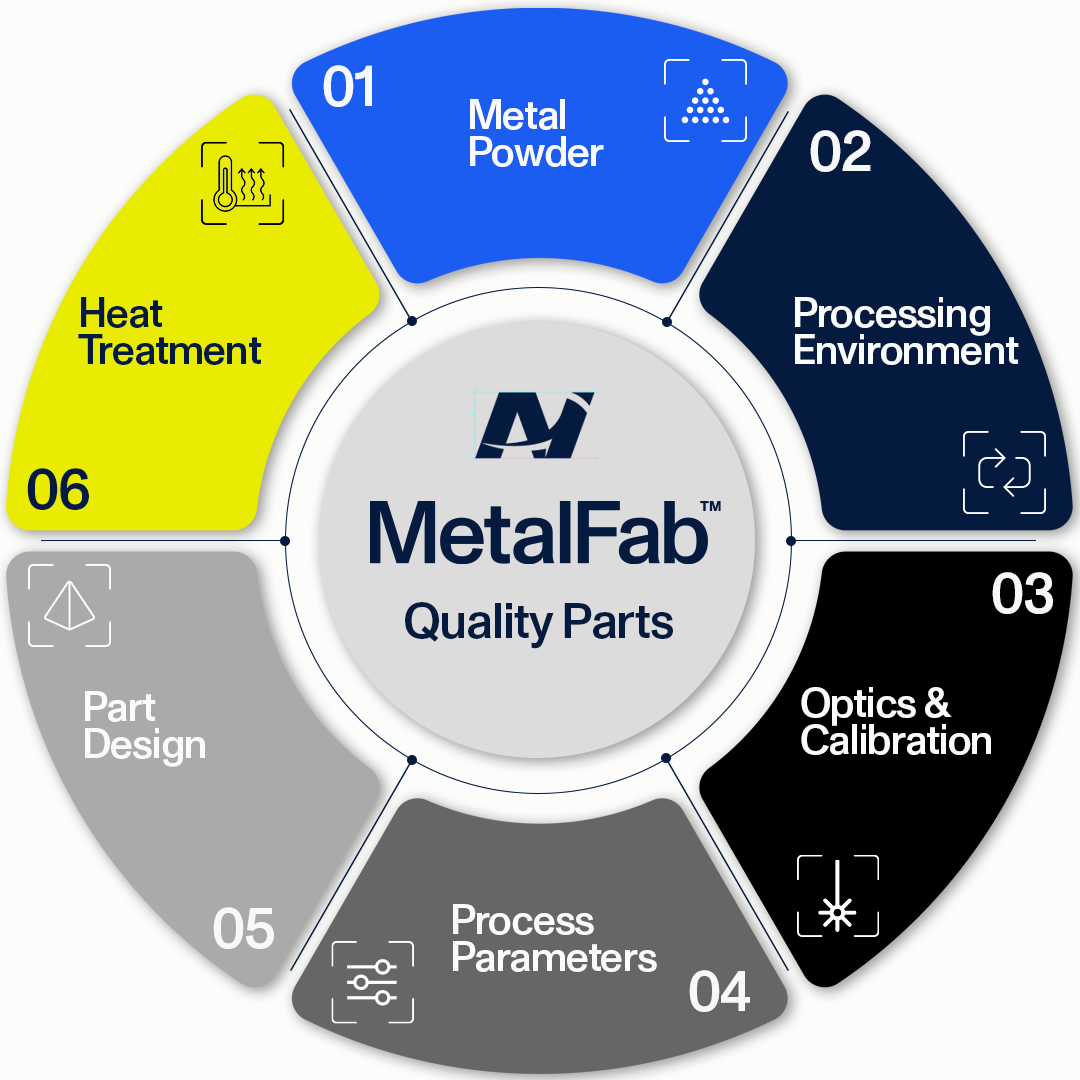
There are many factors which contribute towards the definition of a robust process parameter set and the methodology followed through our PRL process ensures that these factors are fully understood, explored and controlled leading to the production of consistently high-quality parts on our systems.
Because both material characteristics and part geometry are created simultaneously, understanding and controlling these variables is fundamental to success and therefore at the heart of every one of our material parameter sets.
Additive Industries define all released material parameters within 3 categories – Quality, Balanced & Productivity – which provide an indication of their area of application. The starting point for most materials is a ‘Balanced’ parameter set, which gives the best compromise between quality and productivity and allows a wide range of geometries to be successfully produced.
The ‘ Quality’ and ‘Productivity’ parameter sets are generally tailored parameters for specific applications and materials, which can include very high-density, extra thin walls, improved surface quality, high deposition rate with lower material density acceptance criteria etc.
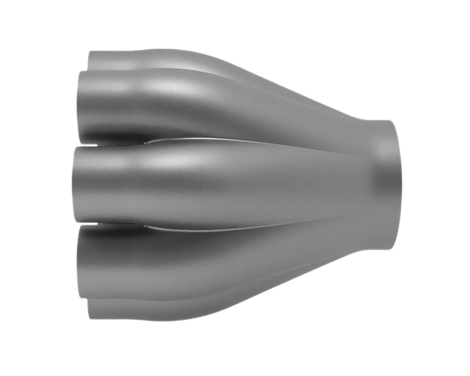
High quality parameter for demanding applications/requirements including:
General purpose parameter for broad range of applications/geometry types:
Increased productivity parameter set based on application specific requirements
The open architecture of the MetalFab system means that customers can develop their own process parameters or modify the baseline parameters provided by Additive Industries as a start point for their specific applications. Whilst some system manufacturers either fully lock and hide the parameters used to produce metal parts (closed architecture) or only allow minimal access or visibility to the processing parameters (semi-open), Additive Industries believe strongly that a customer should be able to fully utilise all the available functionality of their system, because every challenge is different.
We recognize the critical nature of the powder feedstock in our systems, both from a quality and safety perspective, which is why the MetalFab is designed to eliminate exposure of powder particles to both oxygen moisture and human contact.
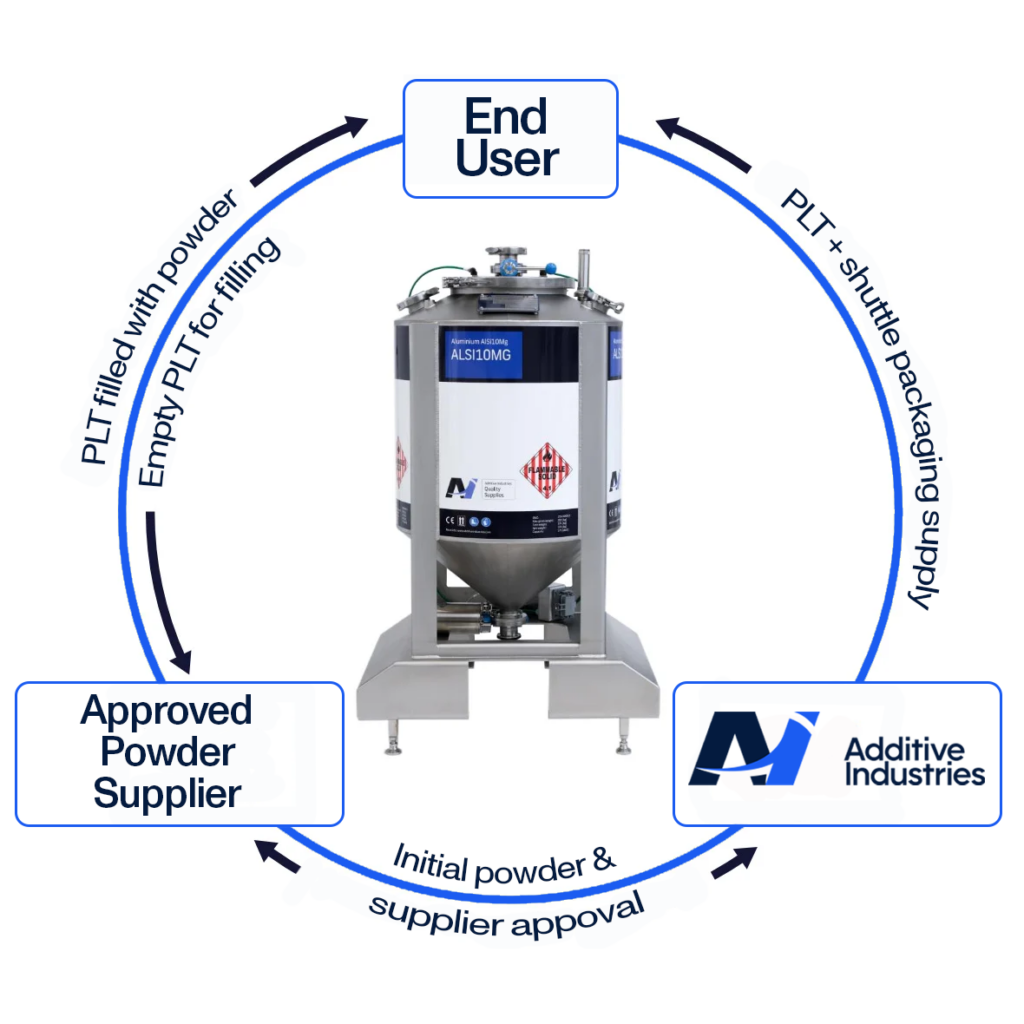
Powder materials can be kept in inert conditions directly from the atomizer and using the Additive Industries Powder Load Tool (PLT) loaded and unloaded directly to and from the system. The system ensures that powder is constantly kept under controlled conditions and no operator contact is necessary via its integrated powder sieving/transportation system and automated powder extraction procedure.
Our systems are compatible with industry standard powder particle size distributions which we specify to ensure the robustness and repeatability of our process parameters and consistency and quality of the parts our systems produce.
Our powder specifications are set to ensure all powders:
PSD is a key part of ensuring powder flowability, and our systems work with various ranges depending on material type –typical PSD ranges for our technology are in the 15-45μm or 20-63μm ranges. It is important for the process to have a distribution of fine and coarse particles to ensure packing in the powder bed and flowability of the powder – this is a sensitive balance and incorrect distribution can lead to poor flowability or entrapped gas porosity
This is another measure which represents the flowability of powder, relating to the shape of the particles and usually measured qualitatively by SEM and/or quantified by measuring the aspect ration of the powder
Moisture has a direct impact on powder flowability – generally powders with high moisture content will not flow well whilst also cause quality issues to arise where moisture is released during the process providing a source of oxidation and Hydrogen pickup. This is why the Additive Industries approach to material control using our PLT is so critical to part quality
Additive Industries systems process powders produced through either gas atomization or plasma atomization technique
Browse our range of metal alloys, each designed for specific additive manufacturing applications.

Or still have questions? Schedule a call with one of our specialists and get you on the path to AM success.